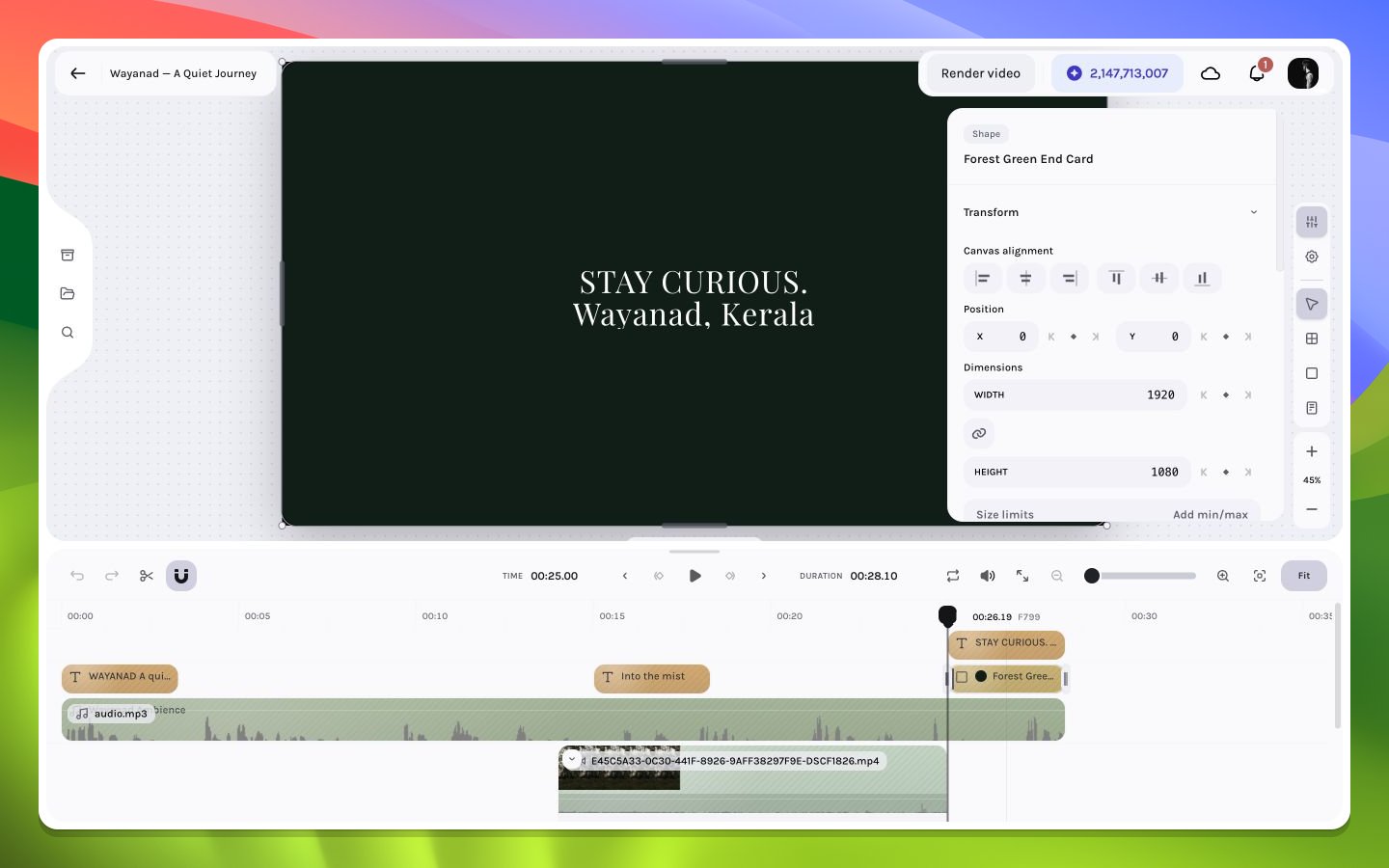
A solid is a lightweight draft-local rectangle. It needs no remote media and is therefore useful for reliable design primitives throughout the composition.
Solid layer used as an end card with inspector controls

A solid end card selected in the inspector

Create and shape

Choose the Solid tool from the right rail and drag on the canvas. Solid is a one-shot tool: releasing the pointer creates a 100-frame layer at the playhead and automatically returns to Select; clicking without dragging creates nothing. The Transform section exposes alignment, position, dimensions, rotation, and scale. Use corner and edge handles for fast sizing, then refine the values numerically.

Appearance

The solid’s fill can be a solid color or two-stop linear gradient. Opacity, blend mode, border radius, stroke width, and solid-only stroke color define the rest of its visual role. A low-opacity dark solid can support text over video; a fully opaque composition-sized solid can become an end card; a narrow solid can act as a divider or progress accent.

Crop

Crop can reduce the visible portion of the rectangle. For ordinary rectangle sizing, prefer dimensions; use crop only when its source-box semantics are part of the intended effect.

Timing and animation

Solids can be timed like any layer. Supported transform, opacity, border-radius, stroke-width, crop-edge, and shadow parameters can be animated. Solids do not expose the layer-effects library. Because they have no media decoder, they are usually inexpensive compared with video or large images.

Layer ordering

Place a backing solid below the text it supports and above the video it darkens. If the solid unexpectedly covers content, inspect layer order before reducing opacity.
Use consistent radii, colors, and padding across title modules. When several elements should remain responsive, parent them inside a frame rather than manually coordinating separate top-level solids.